
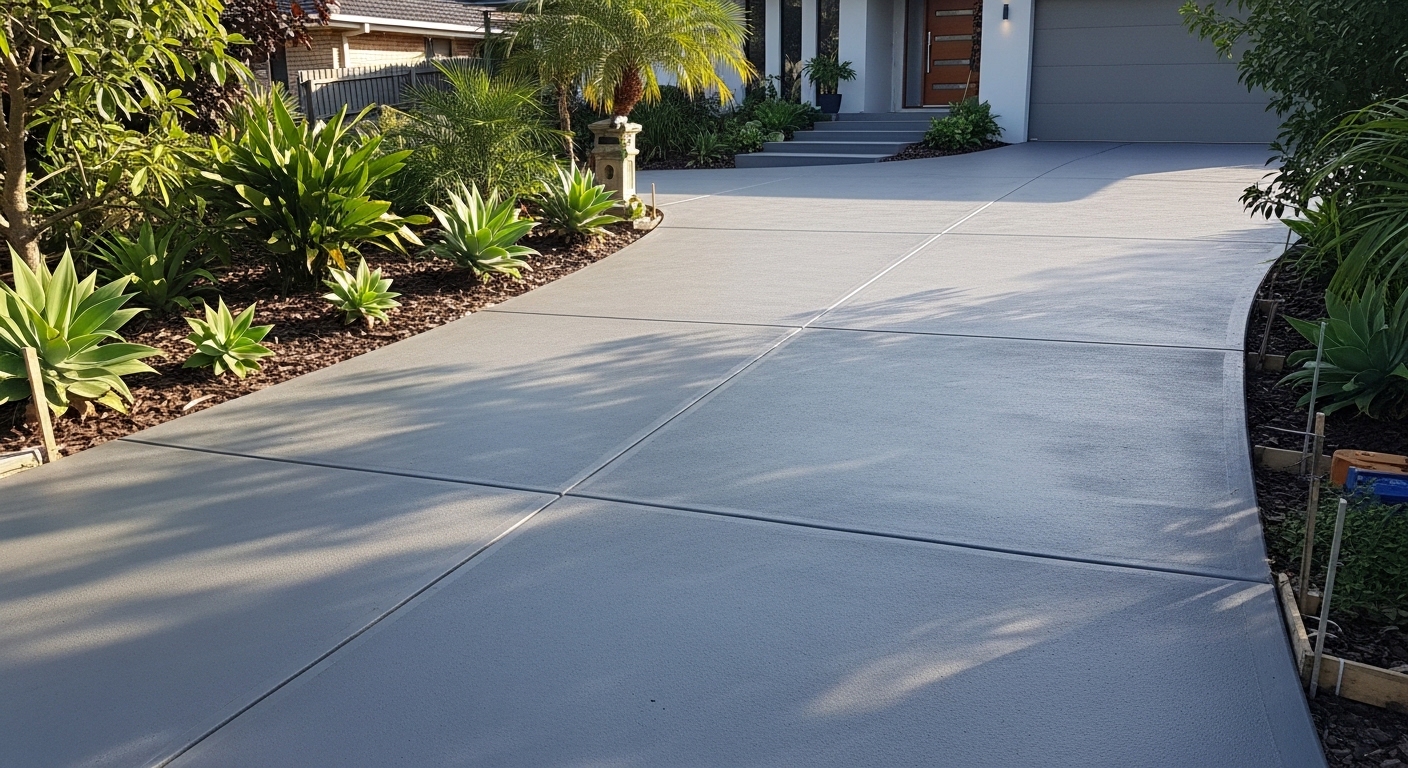

Plain concrete driveways remain one of the most practical and widely installed surfaces for Brisbane residential properties, yet the question of how long they actually last is one that homeowners and property managers frequently underestimate. Plain concrete driveways installed correctly in Brisbane can last 30 years or more, but the lifespan depends heavily on subgrade preparation, concrete mix specification, control joint placement, and how well the slab is maintained through Queensland's demanding subtropical conditions. This article covers what determines driveway longevity in Brisbane, what the current property market is revealing about the cost of neglected concrete, and what property owners should do before committing to a new installation or replacement.
Understanding the lifespan of plain concrete driveways in Brisbane requires looking beyond the surface. Brisbane's reactive clay soils, intense UV exposure, heavy summer rainfall, and high ambient temperatures during the wet season all place specific stresses on concrete slabs that are not present in cooler or drier climates. A driveway that might perform adequately for 25 years in a temperate southern city can deteriorate significantly faster in Brisbane's western and southern suburbs if the concrete mix, reinforcement, and curing method are not matched to local conditions. The sections below explain the full picture, from what the 2025 Brisbane property market is signalling about concrete condition to the specific standards and steps that determine whether a plain concrete driveway lasts a decade or three.
Brisbane Property Market Puts Driveway Longevity Under the Spotlight in 2025
A widely shared property story from May 2025 brought the condition of concrete structures into sharp focus for Brisbane buyers and sellers. According to Real Estate — 15 May 2025, a half-built house in Brisbane's west with 17 years of incomplete construction history came to market in a condition that drew comparisons to ancient ruins. The property's deteriorating concrete structures, exposed reinforcement, and unfinished slabs became a talking point across Brisbane's real estate community, not just because of the unusual listing, but because it illustrated in vivid terms how unfinished and degraded concrete dramatically affects the perceived value and marketability of a property. Buyers and agents commenting on the story noted that concrete condition, including driveways, is one of the first things a prospective purchaser assesses on arrival at a property.
The story triggered a broader conversation among Brisbane homeowners about the lifespan and maintenance of concrete elements, particularly plain concrete driveways, which are often the first visible sign of a property's overall maintenance standard. A driveway that is cracked, settled, or spalling signals deferred maintenance to buyers and can affect sale negotiations well beyond the cost of replacement. According to detailed cost analysis published at How Much Do Concrete Driveways Cost in Brisbane?, the cost of a full driveway replacement in Brisbane typically ranges from A$3,500 to A$8,500 depending on size, site conditions, and finish specification. When that cost is factored into a sale negotiation as a deduction from the asking price, the financial impact on the seller is immediate and measurable. The 2025 Brisbane market story reinforced what property professionals have observed for years: concrete condition is not a cosmetic issue. It is a structural and financial one.
Brisbane's Climate and Soil Conditions Directly Shorten Driveway Lifespan
Brisbane's subtropical climate creates a specific set of challenges for plain concrete driveways that differ from conditions in southern Australian cities. Temperatures regularly exceed 35 degrees Celsius during summer, which accelerates the rate at which fresh concrete loses moisture during curing. When concrete dries too quickly, the surface crazes and weakens before the internal matrix has fully hydrated, producing a slab that looks complete on the day of installation but begins showing surface deterioration within two to three years. Brisbane's wet season, running from November through to March, delivers intense rainfall events that can saturate subgrades, cause differential settlement in poorly compacted fill, and introduce water into existing cracks, accelerating their growth through repeated wet and dry cycles.
The subsoil conditions across much of Brisbane compound these climate effects significantly. Queensland's reactive clay soils, classified as Class M and Class H sites under AS 2870 Residential Slabs and Footings, undergo measurable volumetric movement in response to changes in soil moisture content. During dry periods, the clay shrinks and the slab loses support in localised areas. During wet periods, the clay swells and exerts upward pressure on the slab. Plain concrete driveways not designed for these reactive soil conditions, with appropriate slab thickness, reinforcement, and joint spacing, will crack and heave within a fraction of their intended service life. The Concrete Institute of Australia provides guidance on concrete performance in Australian conditions, including the relationship between subgrade reactivity and slab design. Brisbane City Council's crossover and driveway construction standards also require compliant concrete thickness and reinforcement specifications, meaning that a driveway installed without reference to local soil classification may fail both structurally and from a regulatory compliance perspective. Property owners who ignore these conditions risk driveways that become safety hazards, attract council non-compliance notices, and reduce property value in a market that is increasingly attentive to concrete condition.
How Plain Concrete Driveways Are Built to Last in Brisbane's Conditions
Plain concrete driveways installed to the correct specification in Brisbane follow a defined sequence of steps, each of which directly affects the finished slab's lifespan. The process begins with a site assessment that includes identifying the soil classification under AS 2870. On Class M and Class H reactive clay sites, which are common across Brisbane's western suburbs including Kenmore, Fig Tree Pocket, and Pullenvale, the subgrade must be prepared with particular care. Excavation is carried out to a minimum depth of 100mm below the finished surface level, and the exposed subgrade is compacted or treated before any base material is placed. Subgrade compaction to 95 percent standard proctor density is the standard target, and this step is where the majority of long-term driveway failures originate. A subgrade that is under-compacted by even a small margin will allow differential settlement within a few years, producing cracks that run diagonally across the slab surface and cannot be repaired without full replacement.
Formwork is installed to the correct dimensions and levels before any reinforcement is placed. Standard residential plain concrete driveways in Brisbane use SL82 or SL92 steel mesh reinforcement, positioned at approximately 40 to 50mm from the bottom of the slab to provide tensile resistance against the bending stresses imposed by reactive subsoil movement and vehicle loading. The concrete mix for Brisbane driveways is typically specified at N25 as a minimum, with N32 preferred for driveways subject to heavier vehicle use or reactive soil sites. N32 concrete provides higher compressive strength and improved resistance to the thermal cycling that occurs in Brisbane's climate. According to current concrete cost data for 2026, the price difference between N25 and N32 mix per cubic metre is modest relative to the extended service life the higher-strength mix delivers in Brisbane conditions.
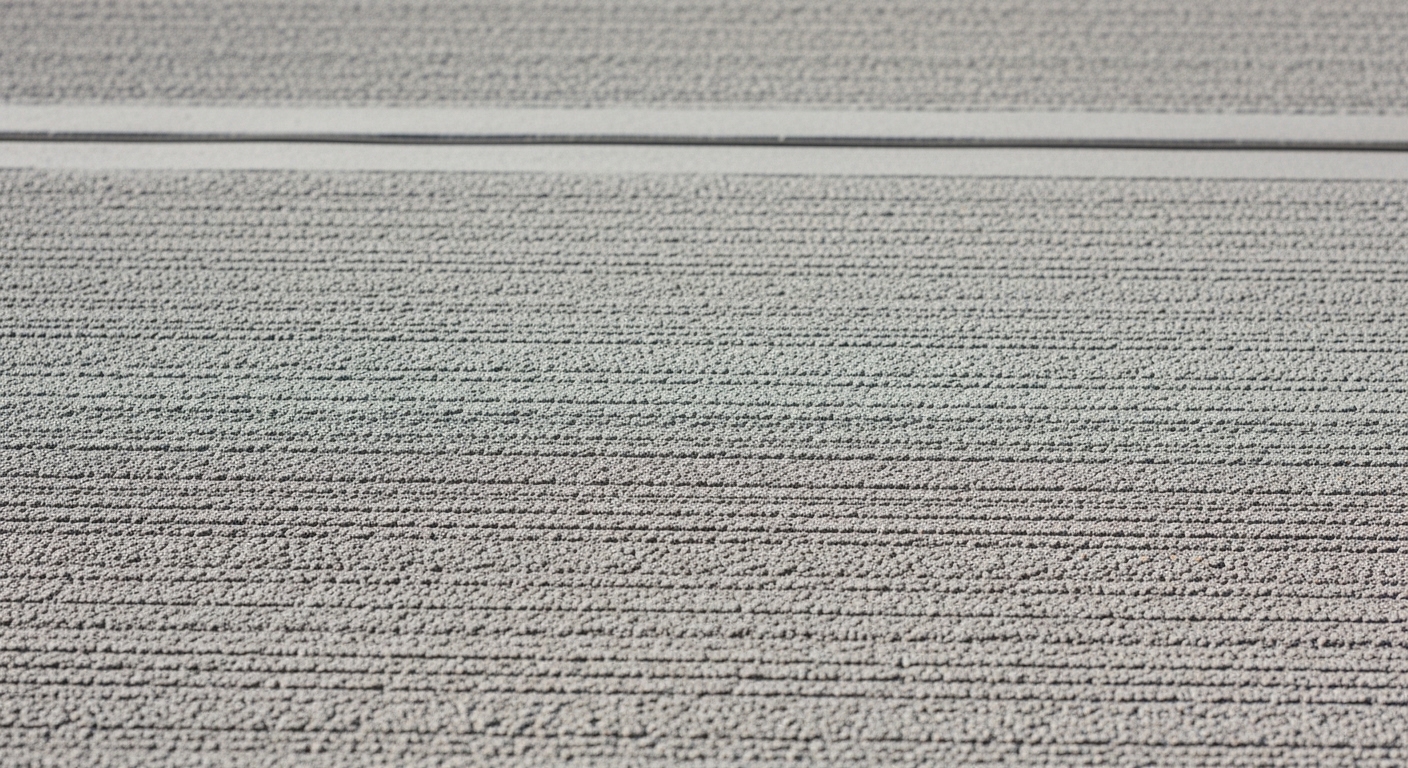
Control joints are cut into the slab at maximum 3 metre intervals, or at a spacing no greater than 25 times the slab thickness, whichever is smaller. These joints are intentional planes of weakness that direct cracking along predictable, manageable lines rather than allowing random surface fractures to develop. A concreter who spaces control joints at 5 or 6 metre intervals on a 100mm slab is producing work that does not comply with the intent of AS 3600 Concrete Structures or the Brisbane City Council Standard Drawing for Residential Driveways and Crossovers. After the pour is screeded and finished with a broom texture for slip resistance, a curing compound is applied or wet hessian curing is maintained for a minimum of 7 days. In Brisbane's summer heat, curing is not optional. It is the single most important factor in whether the surface layer of the slab achieves its design strength. Skipping or shortening the curing period produces surface dusting, crazing, and early delamination that no sealer can reverse. Three visible signs distinguish quality installation from poor work: a consistent broom finish across the entire surface, straight control joints cut to one-quarter of the slab depth, and uniform edge thickness of at least 100mm with no feathered or thin edges. Thin edges are the first part of any plain concrete driveway to crack under vehicle loading, and they are a direct indicator of inadequate formwork setup.
What Brisbane Homeowners Should Do Before Replacing or Installing a Driveway
Before any work begins on plain concrete driveways, the first and most important step is thorough documentation of the existing surface condition. Photograph every crack, area of spalling, settlement depression, and drainage issue with timestamps, ideally from multiple angles. Measure the current driveway dimensions and note where water ponds after rainfall, as drainage patterns reveal subgrade problems that are not visible on the surface. Keep copies of any previous council correspondence about the driveway, including any notices about the crossover or kerb connection. This documentation matters for two reasons: it establishes the baseline condition for insurance purposes, and it gives any contractor you engage a clear picture of what they are working with before they price the job.
Checking Brisbane City Council's requirements before engaging any contractor is a step that many homeowners skip and later regret. Brisbane City Council regulates the construction of residential crossovers, which are the sections of driveway that cross the footpath and connect to the road. These crossovers must meet specific standards for concrete thickness, reinforcement, and setback distances, and a construction permit is required before work begins. The application is submitted through Brisbane City Council's online development portal, and processing typically takes between 5 and 15 business days depending on the complexity of the proposal. Starting driveway work without a crossover permit exposes the property owner to a council rectification notice, which can require the work to be demolished and reinstated at the owner's cost regardless of how well the concrete itself was placed.
Obtaining written quotes for plain concrete driveways requires more than comparing the bottom-line price. A properly detailed quote must specify the concrete mix strength by N-class designation, the type and grade of steel mesh reinforcement, the proposed control joint spacing, the curing method and duration, and the minimum slab thickness. Any quote that does not include these details is incomplete, and a contractor who cannot or will not provide them is signalling that their installation method may not meet the specification required for Brisbane's soil and climate conditions. Obtain at least two written quotes and compare the technical specifications, not just the total cost. A quote that is A$500 cheaper but specifies N20 concrete with no reinforcement detail is not a saving. It is a liability.
Verifying a contractor's licence before signing any contract for plain concrete driveways in Queensland is a legal and financial protection that every property owner should exercise. All residential concreting work in Queensland valued above A$3,300 including labour and materials must be performed by a contractor holding a current Queensland Building and Construction Commission (QBCC) licence. The QBCC licence search is publicly available on the QBCC website and takes less than two minutes to complete. Confirm the licence is current, that it covers the relevant work category, and that the contractor carries public liability insurance of at least A$5 million. A contractor who cannot provide their QBCC licence number on request should not be engaged for any structural concrete work.
The timing of plain concrete driveways installation in Brisbane has a direct effect on the quality of the finished slab. Brisbane's peak wet season from November through to March brings unpredictable heavy rainfall that can interrupt a pour mid-placement, wash surface cement from fresh concrete, and saturate the subgrade before the slab has achieved adequate early strength. Where project timing allows, scheduling new driveway work for the drier months between April and October reduces these risks significantly. If summer installation is unavoidable, early morning pours are strongly preferable, as ambient temperatures are lower and the concrete has more time to develop early strength before the heat of the day accelerates surface drying. Delaying control joint cutting beyond 24 hours after the pour in hot conditions risks uncontrolled cracking developing before the joints are in place to direct stress relief.
There is a clear threshold between maintenance tasks that a property owner can reasonably handle and work on plain concrete driveways that requires a licensed professional. Filling hairline cracks under 3mm in width with a compatible concrete crack filler is a task within the capability of most property owners and can extend the life of an otherwise sound slab. However, any cracking that is wider than 3mm, any settlement that has produced a visible level difference between adjacent slab panels, any drainage failure that is directing water toward a building, and any full driveway replacement or new installation all require a QBCC-licensed concreter. Attempting DIY repairs on a structurally failed slab does not address the subgrade movement causing the failure. It conceals the problem temporarily while the underlying cause continues to worsen, often resulting in a more extensive and costly repair when the slab is eventually assessed by a professional.
Why Licensed Concreters and Compliance Standards Protect Your Brisbane Investment
The regulatory framework governing plain concrete driveways in Queensland exists to protect property owners from substandard work that can cause structural damage, safety hazards, and financial loss. Under the Queensland Building and Construction Commission Act 1991, all residential concreting work valued above A$3,300 including labour and materials must be carried out by a contractor holding a current QBCC licence. This requirement is not administrative formality. It is the mechanism through which the Queensland Home Warranty Scheme is activated for residential projects. QBCC-licensed contractors are required to provide a defects liability period, and their work is backed by statutory warranty protection that gives property owners recourse if defects emerge after completion. Work performed by unlicensed contractors carries no statutory warranty protection, and property owners who engage unlicensed labour have no legal avenue for cost recovery if the driveway fails prematurely. You can verify any contractor's licence status directly through the QBCC licence search portal before signing any contract.
The consequences of non-compliant driveway work extend beyond the absence of warranty protection. Brisbane City Council has the authority to issue rectification notices for driveways and crossovers that do not meet the council's construction standards, requiring the property owner to demolish and reinstate the work at their own expense. Substandard concrete that fails structurally, through inadequate mix strength, insufficient reinforcement, or poor curing, can also affect home and contents insurance claims related to structural damage if the insurer determines that the failure originated in non-compliant construction. The financial exposure from a failed plain concrete driveway is therefore not limited to the replacement cost of the slab itself. It can include council rectification costs, loss of insurance coverage, and reduced property value in a market that scrutinises concrete condition closely.
For Brisbane homeowners considering their options across the full range of driveway surfaces, the Driveway Concreting Brisbane service overview covers the complete range of available finishes and specifications. For those specifically focused on the plain finish option, the Plain Concrete Driveways Brisbane page provides detailed specification information relevant to Brisbane's soil and climate conditions. Choosing a finish and specification that is matched to the site conditions and installed by a QBCC-licensed contractor is the most reliable way to achieve a driveway lifespan that justifies the investment.
Frequently Asked Questions
How long do concrete driveways last in Brisbane?
Plain concrete driveways installed to the correct specification in Brisbane can last between 25 and 40 years. The actual lifespan depends on several factors specific to the Brisbane context: the soil classification of the site, the concrete mix strength used, the quality of subgrade compaction, the spacing and depth of control joints, and how consistently the slab is maintained after installation. Driveways on reactive Class M or Class H clay soil sites that were not designed for subsoil movement typically show significant cracking within 5 to 10 years. Driveways installed with N32 concrete, SL82 or SL92 mesh reinforcement, and properly timed control joints on a well-compacted subgrade routinely reach 30 years without requiring structural intervention beyond periodic sealing.
What thickness should a concrete driveway be in Queensland?
The standard minimum thickness for a residential plain concrete driveway in Queensland is 100mm. This applies to driveways carrying standard passenger vehicles. For driveways that will carry heavier vehicles such as trailers, caravans, or small trucks, a thickness of 125mm to 150mm is typically recommended, with reinforcement upgraded to match the increased load. Brisbane City Council's crossover construction standards specify minimum thickness requirements for the section of driveway crossing the footpath verge, and these must be observed regardless of what thickness is used on the private property section. Slab thickness below 100mm produces thin edges that are highly susceptible to cracking under vehicle loading and should not be accepted on any residential driveway installation in Queensland.
How much does a plain concrete driveway cost in Brisbane?
The cost of plain concrete driveways in Brisbane varies depending on the size of the area, the site conditions, the concrete mix specification, and whether demolition of an existing surface is required. As a general guide, plain concrete driveway installation in Brisbane typically costs between A$65 and A$110 per square metre for a standard residential driveway on a straightforward site. A double driveway of approximately 50 square metres would therefore cost in the range of A$3,250 to A$5,500 for the concrete work alone, with demolition and removal of an existing surface adding A$800 to A$1,500 depending on the thickness and accessibility of the old slab. Sites with reactive clay soils requiring engineered slab designs or additional subgrade preparation will attract higher costs. Obtaining at least two detailed written quotes specifying the concrete mix strength and reinforcement type is the most reliable way to compare pricing accurately.
Do I need council approval for a new driveway in Brisbane?
Yes, in most cases a permit is required from Brisbane City Council before constructing or replacing a residential driveway that includes a crossover connecting to the road. The crossover, which is the section of driveway that crosses the footpath verge between the property boundary and the kerb, must meet Brisbane City Council's construction standards and requires a construction permit submitted through the council's online portal. The permit application typically requires a site plan showing the driveway dimensions, the proposed crossover location, and the setback distances from adjacent infrastructure. Processing times are generally between 5 and 15 business days. Work on the private property section of the driveway that does not involve the crossover may not require a separate permit, but it is advisable to confirm the requirements with Brisbane City Council before commencing any work to avoid rectification notices.
How do I stop my concrete driveway from cracking in Queensland's heat?
Preventing cracking in plain concrete driveways in Queensland's heat requires action at three stages: during installation, immediately after the pour, and in the years following. During installation, the concrete mix should be specified at N32 strength minimum, poured during the cooler part of the day, and placed on a properly compacted subgrade. Control joints must be cut at maximum 3 metre intervals within 24 hours of the pour, before the concrete has hardened sufficiently to resist the stress relief the joints are designed to provide. Immediately after the pour, a curing compound must be applied or wet hessian curing maintained for a minimum of 7 days. This is the most critical step in Brisbane's climate, as premature surface drying in temperatures above 35 degrees Celsius causes surface crazing that weakens the slab permanently. After installation, sealing the driveway every 3 to 5 years with a penetrating concrete sealer reduces moisture ingress and helps the slab resist the wet and dry cycling that accelerates crack growth in Brisbane's subtropical conditions.
Conclusion
Plain concrete driveways in Brisbane can deliver a service life of 30 years or more when the installation is matched to the site's soil classification, the concrete mix is specified correctly, and the curing process is completed in full. The 2025 Brisbane property market story illustrated clearly that concrete condition is a financial issue as much as a structural one, with deteriorated driveways affecting property value and marketability in a market where buyers are paying close attention to maintenance standards. Brisbane's reactive clay soils and subtropical climate create conditions that accelerate failure in driveways not designed for local conditions, making specification and contractor selection decisions more consequential here than in many other Australian cities. The practical next step for any Brisbane homeowner planning a new driveway or replacement is to check Brisbane City Council's crossover permit requirements, obtain written quotes that specify concrete mix strength and reinforcement grade, and verify the contractor's QBCC licence before signing anything.
More Driveway Concreting Services at Urban Concreters Brisbane Brisbane
For more information about Driveway Concreting services at Urban Concreters Brisbane Brisbane, explore the pages below:

