
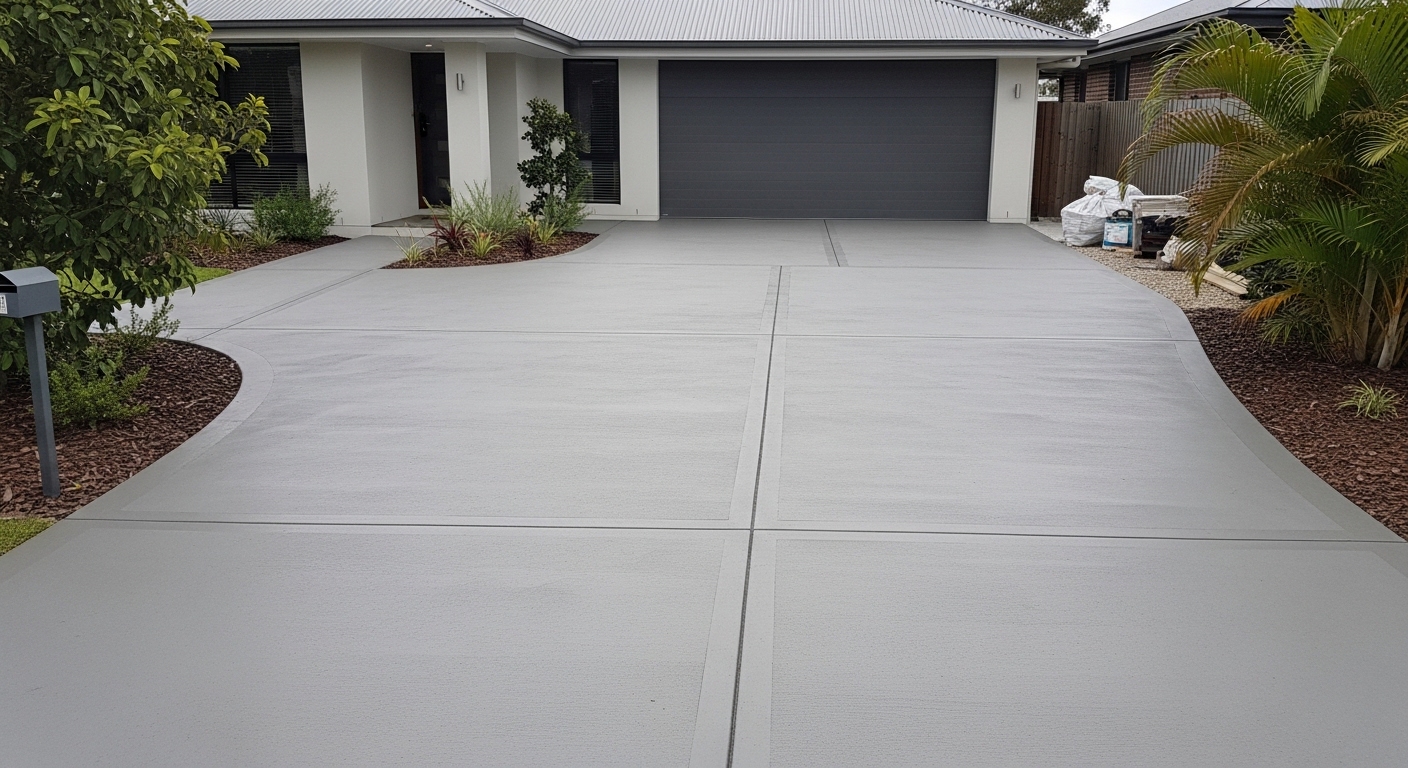

Plain concrete driveways in Brisbane are facing a new level of scrutiny as stormwater management requirements tighten across Queensland. Plain concrete driveways have long been the most common driveway surface installed on residential and commercial properties throughout the city, but the way they handle runoff is now a central concern for councils, certifiers, and property owners alike. Brisbane's subtropical climate, with its intense summer rainfall between November and April, means that a driveway without correct crossfall, drainage connections, and subgrade preparation can cause significant damage to neighbouring properties, footpaths, and road reserves within a single wet season. This article explains what the current regulatory environment means for Brisbane property owners, what a compliant plain concrete driveway must include, and what steps to take before any driveway replacement or redesign begins.
Brisbane Property Market Pressure Exposes Hidden Driveway Compliance Gaps
A property listing that attracted widespread attention across Brisbane in May 2025 brought an unexpected spotlight onto the consequences of incomplete external works. According to Real Estate, a half-built house on a large block in Brisbane's west came to market after a 17-year construction history, drawing public attention because of its unfinished state and its resemblance to ancient ruins. The property's incomplete condition, including external works that had never been finalised, raised immediate questions about council approval status, development compliance, and the market value implications of structures that exist outside approved plans. While the story centred on the house itself, the broader issue it exposed is directly relevant to plain concrete driveways across Brisbane: external works that are incomplete, non-compliant, or constructed without proper approval create serious complications when a property is listed, inspected, or sold.
Plain concrete driveways are classified as impervious surfaces under Brisbane City Council's planning framework. When a driveway is installed or replaced without proper stormwater management, it can direct concentrated runoff onto neighbouring lots or into the road reserve, which constitutes a breach of council requirements regardless of whether a development application was lodged. Properties with non-compliant stormwater management on their driveways face the same scrutiny that the unfinished Brisbane property attracted: council inspectors, building certifiers, and prospective buyers all look at whether external works meet the approved design. For guidance on what Brisbane's concrete driveway costs and specifications look like in practice, the overview at How Much Do Concrete Driveways Cost in Brisbane? provides a useful reference point for understanding what compliant installation involves and what it typically costs in the current Brisbane market.
How Brisbane's Stormwater Regulations Are Reshaping Driveway Requirements Across Suburbs
Brisbane City Council's Stormwater Quality Management Policy and the Queensland Development Code Mandatory Part 1.4 together establish clear obligations for any impervious surface installed on a residential or commercial property. Under these frameworks, plain concrete driveways must be designed so that stormwater runoff is directed to an approved outlet point, which means either a kerb and channel connection at the street, a legal point of discharge to a council stormwater drain, or an approved on-site detention system. Sheet flow across a neighbour's property or uncontrolled discharge onto a footpath is not permitted, regardless of how the driveway has historically functioned. These requirements apply to new installations and to replacement or redesign work on existing driveways.
The consequence for property owners who ignore these requirements is not theoretical. Brisbane City Council has the authority to issue compliance notices requiring rectification of non-compliant stormwater management within a specified timeframe. Where a development application is required and work has proceeded without approval, the council can issue a stop-work order and require demolition and reconstruction of the non-compliant surface at the owner's cost. In flood overlay areas and stormwater-sensitive catchments, which cover substantial portions of suburbs including Rocklea, Oxley, Moorooka, Chelmer, and Corinda in the city's south and west, the requirements are enforced with particular attention. For property owners considering replacing or extending a plain concrete driveway, understanding these obligations before any work begins is essential. Detailed information on compliant driveway drainage design is available through driveway drainage solutions for Brisbane properties.
What Plain Concrete Driveways Must Deliver to Meet Brisbane Stormwater Standards
Plain concrete driveways installed in Brisbane must follow a specific construction sequence to meet both Australian Standard AS 3727-1993 Guide to Residential Pavements and the Queensland Development Code MP 1.4. The process begins with a site assessment and level survey to determine the existing fall across the driveway footprint and to identify the approved stormwater outlet point. This survey determines the crossfall gradient that the finished slab must achieve, which under AS 3727 must be at least 1 percent and no more than 8 percent to ensure water drains away from the structure without creating excessive runoff velocity. Getting this gradient correct at the design stage prevents the most common failure mode seen on Brisbane driveways: ponding water that sits on the surface after rain and eventually penetrates the subgrade through cracks and joints.
Subgrade preparation follows the survey. The natural soil beneath the driveway must be excavated to a consistent depth, typically a minimum of 100mm below the finished slab level, and the exposed subgrade compacted to a minimum of 95 percent standard proctor density. Brisbane's suburban soils vary considerably, with reactive clay profiles common in the southern and western suburbs and sandy loam profiles more typical in the northern and bayside areas. Clay-heavy subgrades require particular attention because they expand and contract with moisture changes, and a subgrade that is not properly compacted and stable will allow differential settlement within two to three wet seasons. Formwork is then set to the surveyed levels, establishing the correct crossfall gradient across the full width of the driveway.
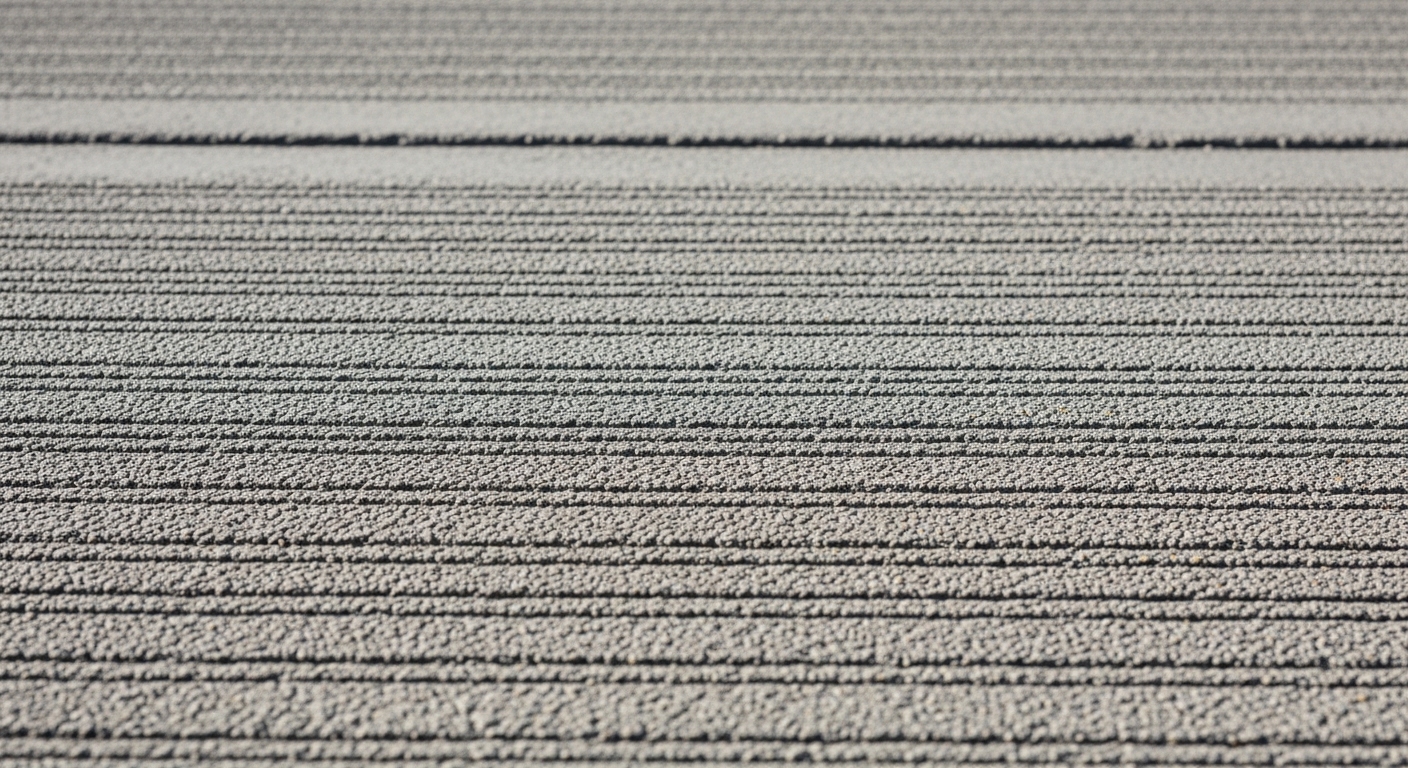
Reinforcement is placed before the concrete pour. Standard residential plain concrete driveways use SL72 steel mesh conforming to AS 4671, positioned at approximately 40 to 50mm from the bottom of the slab. The concrete mix must meet a minimum 25 MPa compressive strength rating, supplied as ready-mix concrete conforming to AS 1379 to ensure consistent mix design and water-to-cement ratio. The pour is finished with a broom or float finish to provide slip resistance, which is particularly important on driveways with steeper crossfall gradients. Control joints are cut or formed at intervals no greater than 3 metres, or at a spacing no greater than 25 times the slab thickness, whichever is smaller. These joints are the mechanism by which cracking is controlled and directed along predictable lines rather than across the visible surface.
The drainage connection is the element that most directly affects stormwater compliance. At the low end of the driveway, a channel drain or agricultural drain must be installed to intercept runoff before it reaches the footpath or road reserve. This drain must be connected by a licensed plumber to the property's approved stormwater system, which in most Brisbane properties means a connection to the kerb and channel or to a council-approved stormwater pit. Sheet flow across a footpath or onto a neighbouring property is not an acceptable drainage outcome regardless of the volume of water involved. The full installation process for compliant plain concrete driveways, including drainage tie-in requirements, is described in detail at Plain Concrete, which covers the scope of work involved in a properly specified installation.
Three visible signs distinguish a compliant installation from one that will cause problems. First, a consistent broom finish across the full surface, with no low spots or depressions visible after light rain, indicates that the formwork was set to the correct gradient and the pour was finished at the right time. Second, straight control joints cut to exactly one-quarter of the slab depth, spaced at no more than 3 metres, show that the contractor followed the AS 3727 specification. Third, a functioning channel drain at the low end of the driveway connected to an approved outlet confirms that the stormwater management requirement has been met. The two most common failure points are insufficient subgrade compaction causing settlement cracking within three years, and the absence of control joints leading to uncontrolled surface cracking that cannot be repaired without full slab replacement. For further context on what new driveway construction involves in Brisbane, the overview at New Concrete Driveways covers the scope of a full installation project.
Steps Brisbane Homeowners Should Take Before Replacing or Redesigning a Driveway
Before any work begins on a plain concrete driveway, the first step is a thorough documentation of the existing surface and its drainage behaviour. Photograph the entire driveway from multiple angles, including close-up images of any existing cracks, spalling, or surface depressions. Use a spirit level to measure and record the existing crossfall direction across the full width of the slab. Note the location of any existing channel drains, stormwater pits, or agricultural drains, and photograph where the drainage outlet connects to the kerb or stormwater system. This documentation matters for two reasons: it establishes a baseline record for insurance purposes if an adjacent property raises a stormwater complaint, and it gives any incoming contractor the information needed to design a replacement that improves on the existing drainage performance rather than replicating its failures.
The second step is to check whether a development application or building approval is required before any demolition or new concrete work begins. Brisbane City Council's online development assessment portal allows property owners to search their address and identify whether the property sits within a flood overlay, stormwater-sensitive area, or character residential zone that triggers additional approval requirements. For most standard residential driveway replacements that do not alter the footprint or drainage outlet point, a building approval rather than a full development application is typically required, but this must be confirmed with a licensed building certifier or directly with the council before work starts. Starting demolition or excavation without confirming the approval pathway can result in a stop-work order and mandatory reinstatement of the original surface at the owner's cost, a situation that adds significant cost and delay to what should be a straightforward project.
Obtaining quotes is the third step, and the quality of a quote reveals a great deal about the contractor's understanding of what compliant plain concrete driveway installation involves. A proper quote for a Brisbane driveway replacement must specify the concrete mix strength in MPa, the reinforcement type and specification, the proposed crossfall gradient, the control joint spacing, the drainage connection method, and the curing period. A quote that lists only a price per square metre without specifying these items is not a compliant scope of works and cannot be used to verify that the finished product will meet AS 3727 or the Queensland Development Code. Obtaining at least three quotes and comparing them on the basis of specification rather than price alone is the most effective way to identify contractors who understand the regulatory requirements and those who do not.
Verifying contractor credentials is the fourth step and one that many property owners skip. In Queensland, all concreting work that forms part of a structure requiring building approval must be carried out by or under the supervision of a contractor holding a current Queensland Building and Construction Commission (QBCC) licence. The QBCC licence register is publicly searchable at the QBCC website, and any contractor's licence status, licence category, and any disciplinary history can be confirmed before signing a contract. The relevant licence category for residential driveway concreting is typically the Concreting licence class under the QBCC's contractor licence framework. In addition to the QBCC licence, the contractor should hold current public liability insurance of at least A$5 million, and the drainage connection work must be carried out by a licensed plumber holding a current Queensland plumbing licence.
Brisbane's wet season, which runs from November through to April, is the most important timing factor for plain concrete driveway installation. Concrete poured during periods of heavy rainfall is at risk of water contamination during the pour, which reduces the compressive strength of the finished slab and increases the likelihood of surface scaling and cracking within the first two years. The ideal installation window in Brisbane is between May and October, when rainfall is lower and temperatures are more consistent, allowing the concrete to cure at a controlled rate over the required minimum of seven days without the risk of rain interruption. Property owners who plan to replace a driveway should aim to have the design confirmed, approvals obtained, and contractor engaged by late April at the latest to ensure the work can proceed during the preferred dry season window.
Professional help is non-negotiable for any plain concrete driveway work that involves a connection to the stormwater system, requires a building approval, or involves excavation of more than 300mm. DIY concrete work on a driveway is not appropriate where the drainage must connect to a council stormwater point, because this connection requires a licensed plumber and must be inspected before it is covered. Any work requiring a building approval must be carried out under the supervision of a QBCC-licensed contractor, and the finished work must pass a council inspection before the approval is closed. Attempting to carry out this work without the appropriate licences voids the statutory home warranty protection that applies to licensed residential building work in Queensland and creates personal liability for any stormwater damage caused to neighbouring properties.
Why Licensed Concreters Are Essential for Stormwater-Compliant Driveway Work in Brisbane
In Queensland, all concreting work that forms part of a structure requiring building approval must be carried out by or under the supervision of a contractor holding a current QBCC licence under the Queensland Building and Construction Commission Act 1991. This requirement applies directly to plain concrete driveways where the installation involves a drainage connection to the council stormwater system or where the driveway forms part of a development application. The QBCC licence framework exists to ensure that residential building work, including plain concrete driveways, is carried out to a standard that protects both the property owner and adjoining landowners from defective workmanship and non-compliant drainage outcomes.
The consequences of non-compliant or substandard driveway work in Brisbane are significant. A driveway that does not meet the stormwater management requirements of Brisbane City Council's planning framework can result in a formal compliance notice requiring rectification within 30 days, a stop-work order if the work is discovered during construction, mandatory removal and reconstruction of the non-compliant surface at the owner's full cost, and potential civil liability for damage caused to neighbouring properties by uncontrolled runoff. These are not hypothetical outcomes. Brisbane City Council's compliance team actively investigates stormwater complaints, and a complaint from a neighbour about runoff crossing a property boundary is sufficient to trigger an inspection and a formal notice.
QBCC-licensed contractors are required to provide statutory home warranty insurance for residential building work valued over A$3,300 under the Queensland Home Warranty Scheme. This insurance covers defective workmanship, including drainage failures that become apparent after the work is complete, for a period of six years for structural defects and one year for non-structural defects. Work carried out by an unlicensed contractor voids this protection entirely, meaning the property owner has no recourse through the scheme if the driveway fails or causes stormwater damage. For properties where drainage design is a critical part of the driveway scope, engaging a contractor with demonstrated experience in driveway drainage solutions ensures that the stormwater connection is designed and installed to the required standard. Further detail on what licensed concrete driveway installation involves in the Brisbane market is available at Concrete By Joe: Concrete Contractor Gold Coast, which outlines the scope and quality standards that apply to professionally installed concrete driveways in the south-east Queensland region. For properties where the existing driveway surface requires treatment after installation, information on protective coatings is available at Driveway Painting Brisbane, which covers surface protection options applicable to plain concrete surfaces.
Frequently Asked Questions
Do I need council approval to replace my driveway in Brisbane?
In most cases, replacing an existing driveway in Brisbane requires a building approval rather than a full development application, provided the replacement does not alter the driveway's footprint, change the drainage outlet point, or involve work within a flood overlay or character residential zone. However, the specific requirements depend on your property's zoning, overlays, and the scope of the proposed work. You should check Brisbane City Council's online development assessment portal using your property address before engaging any contractor or beginning any demolition. Starting work without confirming the approval pathway can result in a stop-work order and mandatory reinstatement of the original surface at your cost. A licensed building certifier can confirm what approvals apply to your specific situation.
What is the minimum thickness for a concrete driveway in Queensland?
Under Australian Standard AS 3727-1993 Guide to Residential Pavements, the minimum slab thickness for a residential concrete driveway in Queensland is 100mm, measured at the thinnest point including the edges. Edge thickness is particularly important because thin or feathered edges are the first part of any driveway slab to crack under vehicle loading. The 100mm minimum applies across the full slab, including at the edges where formwork is set. For driveways subject to heavier vehicle loads, such as those used by trailers, caravans, or light commercial vehicles, a thicker slab of 125mm or more with additional reinforcement may be specified by the engineer or certifier. Slab thickness below the minimum constitutes non-compliant work regardless of the surface finish quality.
How do I stop water pooling on my concrete driveway?
Water pooling on a plain concrete driveway in Brisbane is almost always caused by one of three conditions: insufficient crossfall gradient, low spots created by differential settlement of the subgrade, or blocked or absent drainage at the low end of the slab. The crossfall gradient across a compliant driveway must be at least 1 percent, which means the surface must fall at least 10mm for every 1 metre of width. If the existing driveway has a gradient below this, resurfacing alone will not fix the problem because the underlying slab geometry is incorrect. Settlement-related low spots require investigation of the subgrade condition before any surface treatment is applied. A channel drain at the low end of the driveway, connected to the approved stormwater system, is the correct long-term solution for directing runoff away from the surface.
How long does a concrete driveway last in Brisbane's climate?
A plain concrete driveway installed to the correct specification in Brisbane can be expected to last 25 to 40 years before requiring replacement, provided the subgrade was properly compacted, the concrete mix met the minimum 25 MPa compressive strength rating, control joints were installed at the correct spacing, and the surface has been maintained with periodic resealing. Brisbane's subtropical climate subjects concrete driveways to UV exposure, high humidity, and intense rainfall during the wet season from November to April. These conditions accelerate surface scaling on driveways where the concrete mix was too wet at the time of pour, or where curing was not carried out for the minimum seven-day period. Driveways that were installed without control joints or with insufficient subgrade compaction typically show significant cracking within five to ten years in Brisbane's conditions.
What drainage do I need for a concrete driveway in Brisbane?
A plain concrete driveway in Brisbane must be designed so that stormwater runoff is directed to an approved outlet point and does not discharge as sheet flow onto a neighbouring property, footpath, or road reserve. The minimum drainage requirement for most residential driveways is a channel drain or strip drain installed at the low end of the slab, connected by a licensed plumber to the property's approved stormwater system. This connection must be made to a legal point of discharge, which is typically the kerb and channel at the street frontage or a council-approved stormwater pit within the property boundary. The drainage design must be confirmed before the formwork is set, because the crossfall gradient of the slab determines where the low point falls and where the channel drain must be positioned. Brisbane City Council's Stormwater Quality Management Policy and the Queensland Development Code MP 1.4 both require this connection to be documented as part of any building approval for driveway work.
Conclusion
Plain concrete driveways in Brisbane are no longer a simple concreting task. Stormwater management requirements under Brisbane City Council's planning framework and the Queensland Development Code MP 1.4 mean that every driveway installation or replacement must be designed with correct crossfall gradients, compliant drainage connections, and proper subgrade preparation to avoid compliance notices and potential liability for runoff damage. The attention drawn by Brisbane's incomplete property listings in 2025 reinforced that unfinished or non-compliant external works carry real consequences for property value and council approval status. Before replacing or redesigning a plain concrete driveway, confirm the approval pathway, document the existing drainage, and engage a QBCC-licensed contractor whose scope of works specifies the concrete grade, reinforcement, joint spacing, and drainage connection in writing.
More Driveway Concreting Services at Urban Concreters Brisbane
For more information about Driveway Concreting services at Urban Concreters Brisbane, explore the pages below:

